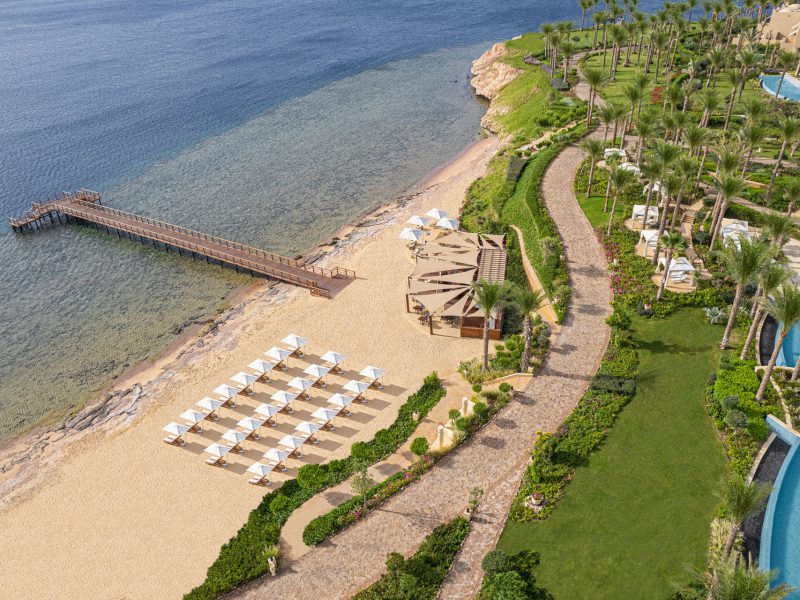
Sharm El Sheikh sits at the point where the Sinai's mountains simply stop, giving way without warning to some of the clearest water in the world.
Sharm El Sheikh sits at the point where the Sinai’s mountains simply stop, giving way without warning to some of the clearest water in the world. Step off a boat here, and the seabed drops away in walls of soft coral, closer to the surface than anywhere else on the Red Sea, close enough that the reef feels like the main event rather than a day trip.
The setting does the work that no amount of resort polish could manage alone. Bare granite peaks rise straight from the coastline, sun-bleached and folded with shadow, while the sea runs through every shade of blue a photograph struggles to hold. Naama Bay curves into cafés and open-air restaurants that spill onto the promenade after dark. Further along, Hadaba’s cliffs drop to the water at Ras Um Sid, where snorkellers slip off the rocks straight onto the living reef without a boat in sight.
What draws people back, though, is what lies beneath. Ras Mohammed National Park, Egypt’s oldest, guards a headland where two seas meet, and strong currents feed reefs thick with soft coral and passing schools of fish. Further out, the Straits of Tiran hold four reefs in a permanent current, prized by divers for the sheer density of life moving through them. And resting upright on the sand nearby, the SS Thistlegorm, a British supply ship torpedoed in 1941, still carries its wartime cargo of motorcycles and lorries, one of the most celebrated wreck dives anywhere in the world.
Sharm gives you both a reef and desert in one place, which is not a claim many resorts can make honestly. An hour or so inland, the Sinai’s interior belongs to the Bedouin tribes who have called this desert home for centuries. Desert safaris by quad bike or 4×4 lead out to camps. At these camps, the Bedouin cook dinner over open fires. The night sky, entirely free of city glow, opens into more stars than most visitors have ever seen at once. Camel treks and stargazing evenings run alongside the more adrenaline-driven excursions, and the contrast with the coast, only an hour away, is total.
Further inland still, Mount Sinai and St Catherine’s Monastery draw travellers willing to rise before dawn. The climb to the summit, traditionally undertaken overnight to reach the top for sunrise, is followed by a visit to the sixth-century monastery below, built around the site where the biblical Burning Bush is said to have stood and still home to an active community of monks. Back on the coast, Sharm’s resorts lean heavily into spa culture, with thalassotherapy and Turkish hammam treatments a fixture of the five-star scene.
For most of its history, this corner of the Sinai had nothing to recommend it beyond fishing grounds and grazing for Bedouin herds. Its value was strategic rather than commercial: whoever held it controlled the shipping lane into the Gulf of Aqaba. Israel occupied the area during the 1956 Suez Crisis and again after the 1967 Six-Day War, beginning the first resort infrastructure. Under the 1979 peace treaty with Egypt, the Sinai was returned in stages, completed in 1982, after which the Egyptian government made rapid tourism development in South Sinai a national priority.
Authorities introduced building height restrictions early in 1983, when Ras Mohammed became Egypt’s first national park, to keep the resort low-rise against its desert backdrop. Sharm El Sheikh became known, somewhat aspirationally, as the “City of Peace” for the diplomatic summits it has hosted since, including a 1996 gathering of world leaders and, in 2022, the United Nations COP27 climate conference. Today it is one of Egypt’s principal gateways for international arrivals, its airport among the country’s busiest.
Sharm rewards visitors most generously in spring and autumn, when daytime temperatures sit comfortably rather than punishingly, and the sea holds its warmth from the summer just gone. The sweet spot, according to many, falls in April and between mid-October and mid-November. During this time, dry, clear days are perfect for diving, desert excursions, and simply sitting by the water.
Summer brings serious heat, with daytime temperatures regularly above 35 degrees through July and August, tempered a little by sea breezes along the coast. Winter is markedly milder by day, though nights can turn properly cold, especially inland, so an evening layer is worth packing even in a beach resort. The Red Sea itself stays warm year-round, at its best for swimming from around August to October and at its coolest, though still swimmable, in January and February.
Sharm El Sheikh is part of a wider selection of EGYPT holidays and accommodation.